


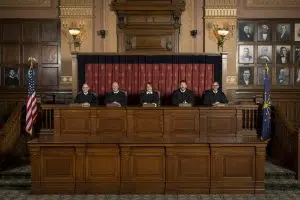
Members of the Indiana Supreme Court. Courtesy - Indiana Supreme Court.
INDIANAPOLIS — Despite confusion and hesitancy among healthcare providers, Indiana’s near-total abortion ban will not take effect until the state Supreme Court certifies its June ruling.
Indiana Supreme Court justices tossed out a wide-ranging preliminary injunction in late June when they largely upheld the state’s abortion ban on constitutional liberty grounds. But until the high court certifies its decision, an injunction remains in place — blocking the new law from taking effect.
At the earliest, decisions can be certified 30 days after a ruling is issued. Because the June 30 ruling was not certified by Monday, it will not take effect on Tuesday. For now, that leaves in place the state’s previous abortion law, which allows abortions up to 20 weeks.
When the law begins being enforced, Indiana will join more than a dozen states with abortion bans. The Republican-dominated Indiana General Assembly advanced the abortion-restricting measure during a heated, two-week special session that concluded in August 2022. That made Indiana the first state in the nation to approve such legislation since the high court ruling that overturned Roe v. Wade.
The ban outlaws all abortions except in the case of a fatal fetal anomaly and cases of serious health risk to the mother. One part of the law says these exceptions are up to 20 weeks but another part says they can be used anytime. Rape survivors can get an abortion up to 10 weeks post-fertilization.
It also strips abortion clinics of their state medical licenses and provides that only hospitals and hospital-owned ambulatory surgical centers can provide abortions. Existing Indiana law makes it a felony for a doctor to perform an illegal abortion, and under the newly-enacted legislation, most abortions will be illegal. There are no criminal penalties for women who seek abortions.
The final language of the ban states explicitly that it does not apply to in vitro fertilization, miscarriages, or ectopic pregnancies. Also, the ban will not limit access to the “morning after” pill or any forms of contraception. Planned Parenthood said it plans to keep its four Indiana clinics that offer abortions open and provide sexually transmitted disease testing and treatment alongside contraception and cancer screenings, which it says comprise the bulk of its services.
Indiana University Health, the state’s largest hospital system, said it has advisory teams available for physician consultations on whether patients meet the legal requirements for abortions.
See the full story here.