


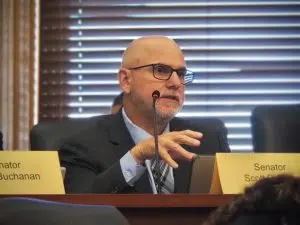
Sen. Scott Baldwin, R-Noblesville, critiques data collection at a Fiscal Policy interim committee meeting on Oct. 10, 2023. Courtesy - (Leslie Bonilla Muñiz/Indiana Capital Chronicle)
INDIANAPOLIS — Indiana lawmakers on Tuesday reviewed the results of a “first-of-its-kind” request of higher education cost and debt data — and found it lacking.
The data was riddled with holes from institutions unable to submit the desired data in the correct format or within the narrow timeframe allowed, and peppered with limitations.
“I think we don’t have the data to say anything at this point,” said Rep. Jeff Thompson, R-Lizton, at the interim study committee on fiscal policy’s sole meeting Tuesday. He is vice-chair.
Policymakers should reframe their requests and allot more time for data collection, said the nonpartisan agency tasked with conducting the analysis.
Legislators also critiqued the universities for declining to present before the committee, pointing to the institutional representatives observing silently from the back row of the room.
The interim committee asked more than a half-dozen public higher education institutions for student loan debts, alumni salaries, staff salaries, program provision costs, and more.
In August, it made its initial request and gave the institutions — including Ivy Tech Community College, Ball State University, and multiple Purdue University campuses — less than six weeks to hand over data in mid-September. But they worked up to Monday night on some elements, Indiana Legislative Services Agency Fiscal Analyst Austin Spears told lawmakers.
Spears cautioned multiple times that the institutions often defined and recorded metrics differently, complicating his agency’s attempts to compare data across institutions. Small program sizes at given degree levels also meant small — and volatile — sample sizes, he said.
Still, the agency found that the average Hoosier higher education student owed less in debt in 2022 compared to a decade prior, even without accounting for inflation.
Those who obtained short-term certificates from Ivy Tech in 2012 owed more than $8,000 on average, but 2022 graduates owed less than $1,000 on average, according to Spears’ slides. Vincennes University reported a drop from about $11,000 in loan debt to $8,000 during that time period.
Students who obtained long-term certificates and associate degrees in 2022 also owed less debt on average compared to 2012, in non-inflation-adjusted dollars — except at Ball State University.
Spears noted smaller loan debt declines for bachelor’s degrees and a “mixed bag” for master’s and doctoral degrees.
See the full story and more of the Indiana Capital Chronicle’s work here.