


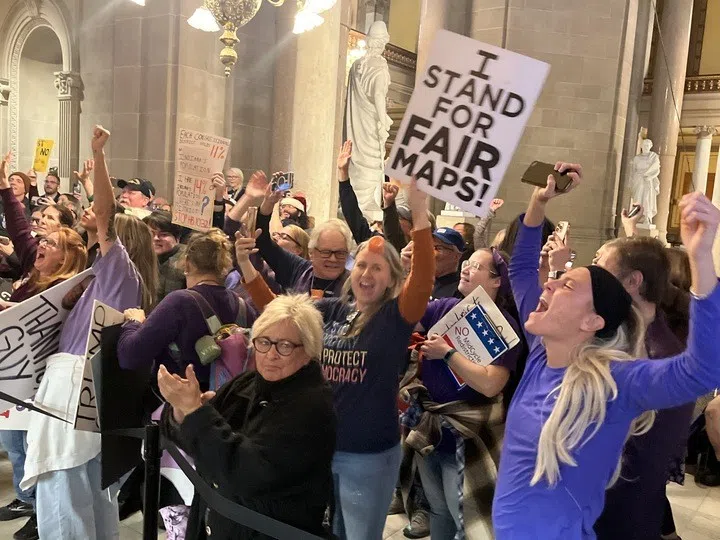
INDIANAPOLIS – The Republican-dominated Indiana Senate spurned months of demands from President Donald Trump as it voted 31-19 on Thursday to reject a redrawing of the state’s congressional maps.
The outcome remained uncertain until 21 Republicans joined all 10 Democratic senators in blocking the redistricting plan. The proposal didn’t even win support from a majority of the 40 Republican senators.
With that tally, Indiana became the first Republican-led state Legislature to vote down Trump’s wish to squeeze out more GOP-friendly congressional seats in hopes of improving the party’s chances of keeping its slim U.S. House majority after the 2026 midterm elections.
Thursday’s Senate outcome came even with Trump, Gov. Mike Braun, and other redistricting supporters continuing to cajole and politically threaten senators who opposed the move.
“I am very disappointed that a small group of misguided State Senators have partnered with Democrats to reject this opportunity to protect Hoosiers with fair maps and to reject the leadership of President Trump,” Braun said in a statement following the vote. “Ultimately, decisions like this carry political consequences. I will be working with the President to challenge these people who do not represent the best interests of Hoosiers.”
The Indiana House last week approved the new maps crafted by the National Republican Redistricting Trust to produce a 9-0 Republican delegation. It did so by carving up the two districts currently held by Democratic Reps. André Carson in Indianapolis and Frank Mrvan in the area along Lake Michigan near Chicago.
But the Senate’s Republican leader, President Pro Tem Rodric Bray, had said repeatedly that too few GOP senators supported the mid-decade redistricting for it to pass.
Bray downplayed the prospect of retribution from the White House after Trump and Vice President JD Vance publicly criticized him and other Republican senators.
“It’s their prerogative to have opinions about what we’re doing here. So, that’s fair,” he said.
Asked whether he was concerned about possible loss of federal funding or other consequences, Bray appeared unmoved.
“I’ve had lots of conversations with folks in Washington, D.C.,” he said. “Indiana will continue to function.”
Read the entire Indiana Capital Chronicle article here.