

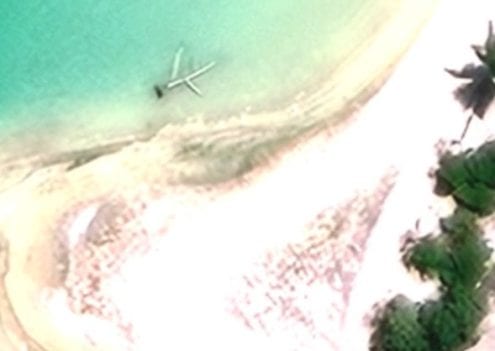
NIKUMARORO, Kiribati — Almost 90 years after the plane went down, the search for what could be Amelia Earhart’s Lockheed Electra 10-E continued last week in Nikumaroro's Lagoon. Unfortunately, on Sunday, Oct. 18, the research team confirmed that the object it thought might be the plane was not Earhart's aircraft.
On Wednesday, October 14, members of the Taraia Object expedition, a joint effort between the Archaeological Legacy Institute, Purdue Research Foundation, and Purdue University, began an underwater survey.
The 17-person team traveled by sea for five days from Tarawa, Kiribati, to Nikumaroro, a remote South Pacific atoll. The team’s goal is to search for evidence of the castaway hypothesis. The theory is that when Earhart and her navigator Fred Noonan disappeared in July 1937 on the third-to-last leg of her round-the-world flight attempt, they landed on this uninhabited island.
Work on Nikumaroro focuses on inspecting the Taraia Object, first noticed in satellite imagery in 2020 and later confirmed by aerial photos of the island’s lagoon in 1938.
The Purdue Research Foundation originally funded the Lockheed Electra “Flying Laboratory” through the Amelia Earhart Fund for Aeronautical Research as part of Purdue’s pioneering efforts in aviation. Earhart intended that the plane be returned to Purdue after completing her historic flight.
On the first day of field operations, the maritime archaeology team began surveying the lagoon using a magnetometer and side-scan sonar technology. The team is gathering data that will be analyzed to create a more accurate picture for later search techniques.
 Columbus Firemen's Cheer Fund 'Chili Cook-Off' returns next month
 'Mill Race Monster Festival' is this weekend
 Semi hits I-65 bridge over U.S. 31
 New traffic pattern for Mallory Parkway at US 31 begins this week
 JCCF 'Community Needs Grant Cycle' is open